How to Calculate PTO Accrual (With Formulas and Examples)
How to calculate PTO accrual step by step: the accrual rate formula, per-hour, per-pay-period, and annual methods, plus worked examples and common mistakes.
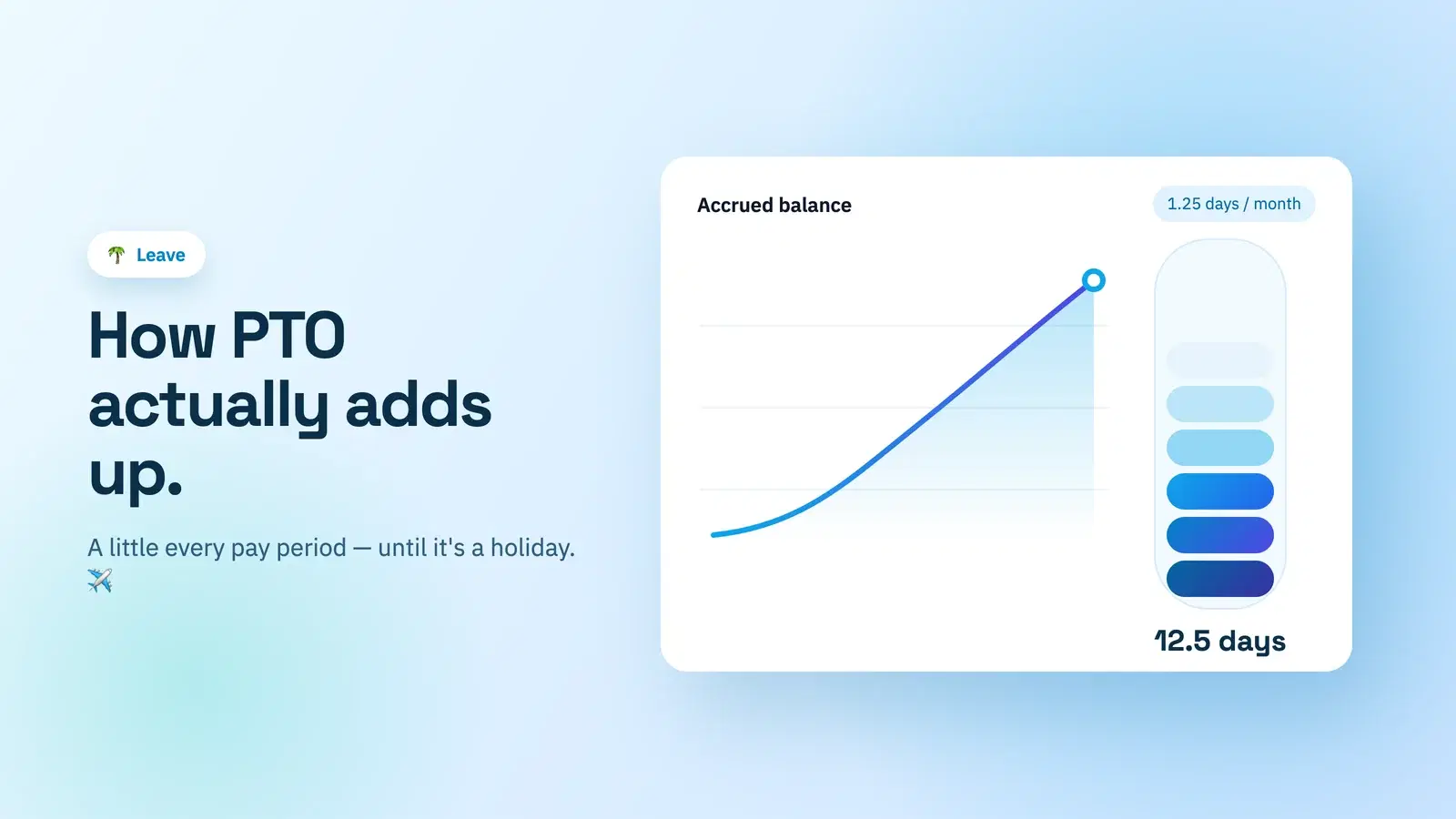
"How much leave do I actually have?" is one of the most common questions any HR inbox gets, and the honest answer for a lot of small teams is "let me check the spreadsheet and get back to you." The reason it's hard is that paid time off isn't a fixed number sitting in an account. It builds up over the year, a little at a time, through a process called accrual — and if you can't calculate accrual cleanly, you can't answer the question with confidence.
The good news: accrual is just division and addition. Once you see the three methods, it stops being mysterious.
TL;DR
- PTO accrual is how paid time off builds up over the year rather than arriving all at once.
- Three methods: annual (all up front), per-pay-period (a slice each payroll run), and per-hour-worked (best for part-time/hourly staff).
- The accrual rate is annual PTO divided by the number of periods (or hours) you accrue over.
- Watch the edge cases: mid-year joiners, caps, and carryover — that's where balances drift.
What PTO accrual actually means
Accrual means earning paid time off gradually as you work, instead of receiving the whole year's allowance on day one. If someone gets 20 days of paid time off a year on an accrual basis, they don't have 20 days available in January — they have whatever they've earned so far, and the balance grows each period until it reaches 20 by year end.
Employers use accrual because it's fairer and less risky: someone who leaves in March hasn't "used up" a full year's leave they never earned. It also smooths the liability on your books. The trade-off is that it needs calculating, which is where the methods come in.
The accrual rate formula
Every method is a version of one idea:
Accrual rate = Annual PTO entitlement ÷ Number of accrual periods
The "period" is whatever unit you accrue over — hours worked, pay periods, or the whole year. Pick the unit, divide, and you have the amount to add each time.
The three accrual methods
| Method | Accrual rate | Best for |
|---|---|---|
| Annual (lump sum) | Full entitlement, granted once | Simplicity; salaried teams with stable headcount |
| Per pay period | Annual PTO ÷ number of pay periods | Most salaried teams; smooth, predictable |
| Per hour worked | Annual PTO hours ÷ annual hours worked | Part-time and hourly staff |
1. Annual (granted up front)
The whole entitlement lands at the start of the year (or work anniversary). Simplest to understand, but you carry the full liability from day one and have to claw back over-taken leave if someone leaves early. Fine for small, stable salaried teams.
2. Per pay period
Split the annual entitlement evenly across your pay periods. If you pay monthly and grant 24 days a year, that's 24 ÷ 12 = 2 days added each payroll run. Predictable and tidy, which is why most salaried teams use it.
3. Per hour worked
The fairest method for variable hours. Divide annual PTO hours by annual hours worked to get PTO earned per hour.
- Annual PTO: 80 hours
- Annual hours worked (full-time): 2,080
- Accrual rate: 80 ÷ 2,080 ≈ 0.0385 hours of PTO per hour worked
Someone who works 120 hours in a period earns 120 × 0.0385 ≈ 4.6 hours of PTO. Part-timers accrue proportionally to what they actually work — no manual adjustment needed.
A worked example
Say a full-time employee gets 15 days (120 hours) of PTO a year, accrued per pay period, paid twice a month (24 periods).
- Accrual per period: 120 ÷ 24 = 5 hours
- After 6 months (12 periods): 12 × 5 = 60 hours earned
- If they've taken 16 hours: 60 − 16 = 44 hours available
That "available" figure — earned minus taken — is the number the employee actually wants when they ask. Keeping it correct in real time is exactly what a spreadsheet struggles with, as we cover in leave management for small teams.
Where accrual goes wrong
Three edge cases cause almost every accrual dispute:
- Mid-year joiners. Start the accrual from their join date, not January, or you'll over-grant.
- Caps. A maximum balance pauses accrual until the person takes time off. Without one, balances balloon.
- Carryover. Decide what happens to unused time at year end — carry over, cap the carryover, or forfeit — and write it down. This belongs in the same policy as your other leave rules; our sick leave policy guide shows how to document leave rules cleanly.
Doing this in Tickin
Tracking the balance is arithmetic that should never be done by hand. Tickin uses a fixed annual entitlement per leave type: you set each employee's yearly allowance, it renews automatically each leave year on their work anniversary, and approved leave is subtracted as it's taken. Everyone sees their real remaining balance before they request time off, so nobody overbooks and the "how much do I have?" question answers itself. (Tickin tracks a set annual entitlement with automatic renewal rather than per-hour or per-pay-period accrual — if you need worked-hours accrual, calculate the rate as above and set the resulting entitlement.)
Because leave lives beside attendance and payroll, accrued and taken time flow straight into the record. See the leave management feature, and start your rules from the free leave policy template. If you want a morning snapshot of who's off, pair it with automating your daily leave and WFH report.
Tickin is free for up to 10 people, then $2 per employee each month on Starter.
Frequently asked questions
How do you calculate PTO accrual?
Divide the annual PTO entitlement by the number of periods you accrue over. For an hourly rate, divide annual PTO hours by annual hours worked. For a per-pay-period rate, divide annual PTO by the number of pay periods. Each period, add that amount to the employee's balance.
What is a PTO accrual rate?
It's the amount of paid time off an employee earns per unit of work, usually per hour worked or per pay period. For example, 80 hours of PTO a year over 2,080 working hours is an accrual rate of about 0.0385 hours of PTO per hour worked.
What are the main PTO accrual methods?
The three common methods are annual (the full entitlement granted up front), per-pay-period (an equal slice added each payroll run), and per-hour-worked (PTO earned in proportion to hours, which suits part-time and hourly staff).
How do you handle a PTO accrual cap?
A cap is a maximum balance an employee can hold. Once they reach it, accrual pauses until they use some time off and drop below the cap. It stops unused balances from growing indefinitely and encourages people to actually take leave.
Where to go from here
PTO accrual is just a rate applied every period, plus a few edge cases handled honestly. Pick the method that fits how your team works — per pay period for salaried, per hour for variable — set the rate, and handle joiners, caps, and carryover on purpose rather than by accident.
Rather not track balances by hand? Start free with Tickin and let annual entitlements renew and update on their own as leave is approved, then read leave management for small teams to put the whole system in place.