Payroll Deductions Explained: Gross to Net, Step by Step
What payroll deductions are, the difference between statutory and voluntary and pre-tax and post-tax, and how gross pay becomes net pay, with a clear example.

Every employee has had the same small moment of confusion: the salary you agreed to and the amount that lands in your account are not the same number. The gap between them is payroll deductions, and while the idea is simple, the order and the categories trip up a lot of people who run pay for the first time.
Get deductions right and payroll is calm and defensible. Get them wrong and you're issuing corrections, fielding "why is my pay short?" messages, and, in the case of statutory items, potentially on the wrong side of the law.
TL;DR
- Payroll deductions are amounts taken from gross pay; what remains is net pay.
- They split two ways: statutory (required by law) vs voluntary (agreed by the employee), and pre-tax vs post-tax.
- Pre-tax deductions lower taxable income; post-tax ones don't — so the order you apply them changes the tax due.
- Every deduction belongs on its own payslip line, so the gross-to-net path is fully checkable.
What a payroll deduction is
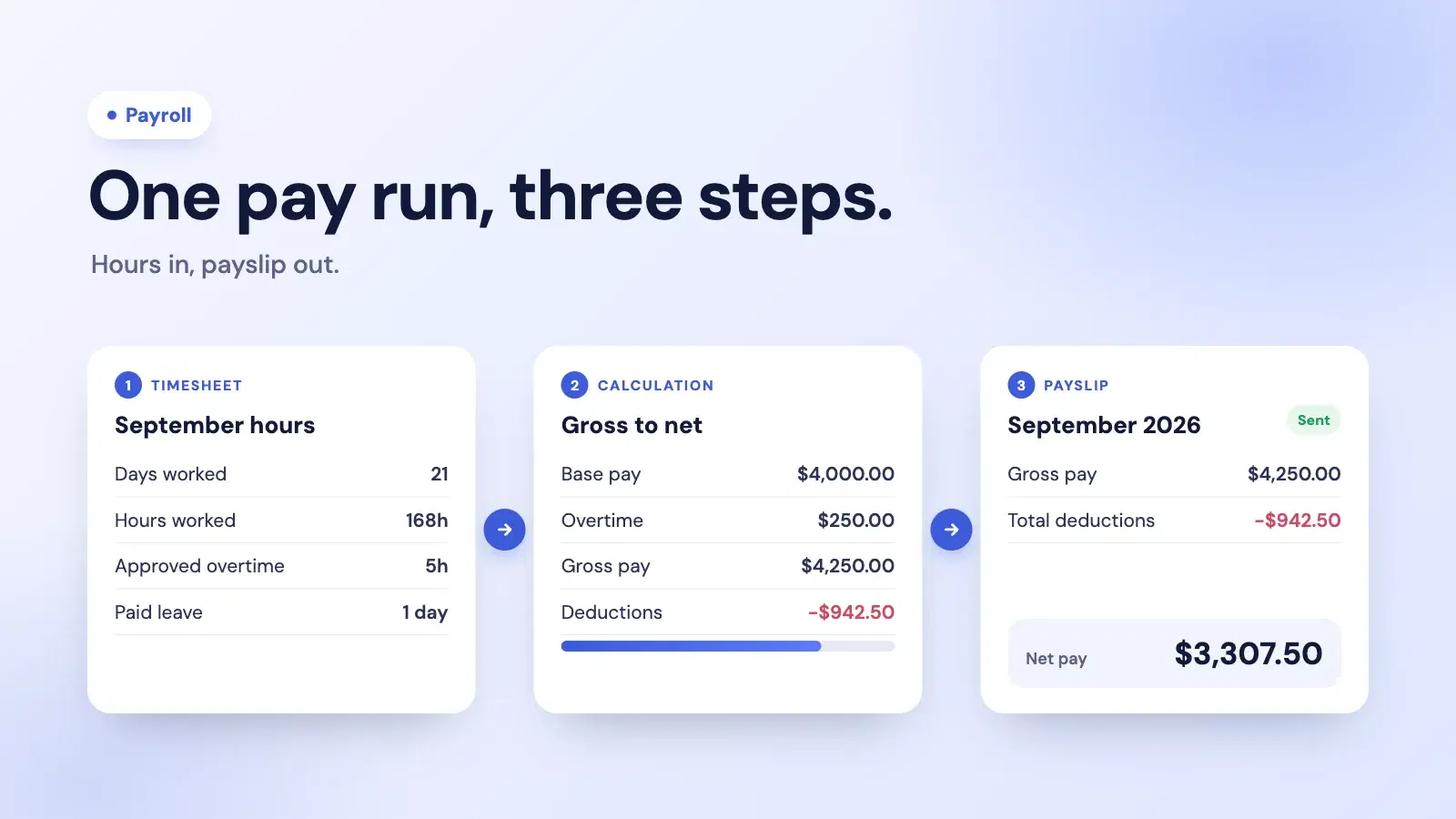
A payroll deduction is any amount an employer withholds from an employee's gross earnings before paying them. Gross pay is what someone earned; net pay — often called take-home pay — is what's left once every deduction is applied. The whole job of payroll is to get from one to the other correctly, and to be able to show the working. That "show the working" part is exactly why each deduction sits on its own line of a payslip.
The two ways deductions are categorized
Deductions get sorted along two independent lines. Understanding both is the key to the whole topic.
Statutory vs voluntary
| Type | Who decides | Examples |
|---|---|---|
| Statutory | Required by law | Income tax withholding, social security / pension contributions, other mandated levies |
| Voluntary | Agreed by the employee | Extra retirement savings, insurance top-ups, union dues, salary advance repayments |
Statutory deductions aren't optional — you must withhold and remit them, and the rules vary by country. The concept of a payroll tax exists in most jurisdictions even though the rates and names differ. Voluntary deductions only happen with the employee's consent, and you should keep a record of that agreement.
Pre-tax vs post-tax
This is the one that changes the math. A pre-tax deduction comes out before income tax is calculated, which lowers the taxable amount and therefore the tax owed. A post-tax deduction comes out after tax is worked out, so it has no effect on the tax bill. Whether a given item is pre- or post-tax depends on your local rules, but the principle is universal: sequence matters.
Gross to net, in order
Here's the sequence that turns gross pay into net pay. Follow it in this order every time.
- Start with gross pay — base salary plus overtime, bonuses, and allowances. (If overtime is part of the picture, how to calculate overtime pay covers that step.)
- Subtract pre-tax deductions — this gives you taxable income.
- Calculate income tax on that taxable income.
- Subtract the tax and any post-tax deductions.
- What remains is net pay.
A worked example
| Line | Amount |
|---|---|
| Gross pay | 120,000 |
| Pre-tax retirement contribution | −6,000 |
| Taxable income | 114,000 |
| Income tax (on 114,000) | −11,400 |
| Post-tax loan repayment | −5,000 |
| Net pay | 97,600 |
Notice that the retirement contribution came before tax, so tax was calculated on 114,000, not 120,000. Move that same contribution to post-tax and the tax figure — and the net — would change. That's why "gross vs net pay" is never a single subtraction; it's a sequence.
The tax line above is a flat 10% to keep the example readable. Real income tax is almost always progressive, so the rate rises across bands rather than applying evenly to the whole amount. If you run payroll in Pakistan, the Pakistan salary tax calculator applies the current FBR slabs to a gross salary and returns the monthly tax and take-home figure, which is quicker than working the bands by hand.
To run your own numbers, the free payroll deductions calculator takes gross pay and each deduction, as an amount or a percentage, and shows net pay line by line.
Why clean deductions matter
Deductions are where payroll trust is won or lost. Roll several into one lump and you invite the question a payslip exists to prevent. List each on its own line — statutory items named, voluntary ones the employee agreed to — and the whole calculation becomes something anyone can audit. It also protects you: a clear, itemized record is your evidence if a deduction is ever queried.
Doing this in Tickin
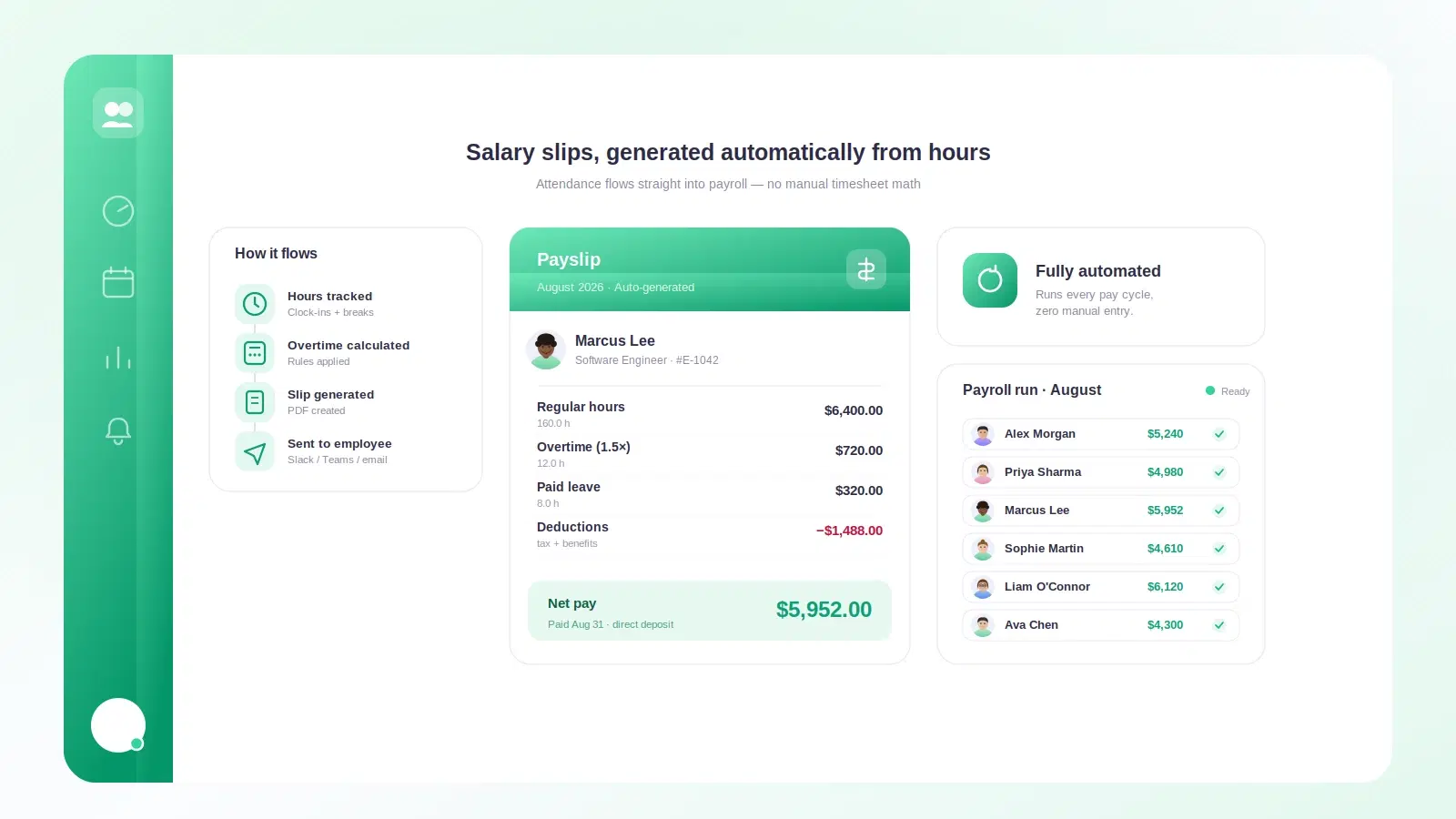
Deductions go wrong when they're re-entered by hand every cycle. Tickin keeps your earnings and deduction lines in one place and applies them in the right order — pre-tax before tax, post-tax after — so gross-to-net is calculated the same way for everyone, every period. Each deduction lands on its own payslip line, itemized and checkable, and it's pro-rated correctly for partial periods.
You define your components once on the Growth plan; Tickin does the sequence. See the payroll feature, or if you still run pay by hand, the payroll processing checklist is a free starting point. When you're ready, this is how attendance and leave turn into finished payslips — the same idea behind automating salary slips.
Tickin is free for up to 10 people, then $2 per employee each month on Starter.
Frequently asked questions
What are payroll deductions?
Payroll deductions are amounts taken out of an employee's gross pay before they receive it. Some are required by law, like income tax and social contributions, and others are voluntary, like retirement savings or loan repayments. What's left after all of them is net pay.
What's the difference between statutory and voluntary deductions?
Statutory deductions are legally required and you have no choice but to withhold them, such as income tax and mandated social or pension contributions. Voluntary deductions are ones the employee agrees to, like additional retirement savings, insurance top-ups, or a salary advance repayment.
What is the difference between pre-tax and post-tax deductions?
A pre-tax deduction is taken from pay before income tax is calculated, so it lowers taxable income. A post-tax deduction comes out after tax is worked out. The order matters because pre-tax items reduce the tax due, while post-tax ones don't.
How do you calculate net pay from gross?
Start with gross pay, subtract any pre-tax deductions, calculate income tax on what remains, then subtract that tax and any post-tax deductions. The final figure is net pay, the amount that actually reaches the employee.
Where to go from here
Payroll deductions look intimidating until you separate the two questions they really ask: is this required or agreed, and does it come before or after tax? Answer those, apply them in order, and put every one on its own line. Do that and gross-to-net stops being a mystery and becomes a calculation anyone can follow.
If you'd rather your deductions apply themselves correctly every cycle, start with Tickin (payroll is on the Growth plan), then read what is a payslip to see where these lines land on the final document.