Payroll Software vs a Payroll Service: Which Does Your Business Need?
Payroll software calculates pay; a payroll service also pays people and files taxes. What each does, what it costs you in time, and how to choose.
"Payroll" is used for two quite different things. One is a tool that works out what each person is paid. The other is a company that also pays them and deals with the tax authorities. Choosing between them is mostly a question of who will do the last, riskiest steps.
This guide says plainly what each one does, so you can decide which your business needs. If you want the basics of payroll first, start with what payroll is.
What payroll involves
Every pay run has the same steps:
- Collect the inputs: hours, leave, overtime, new starters and leavers.
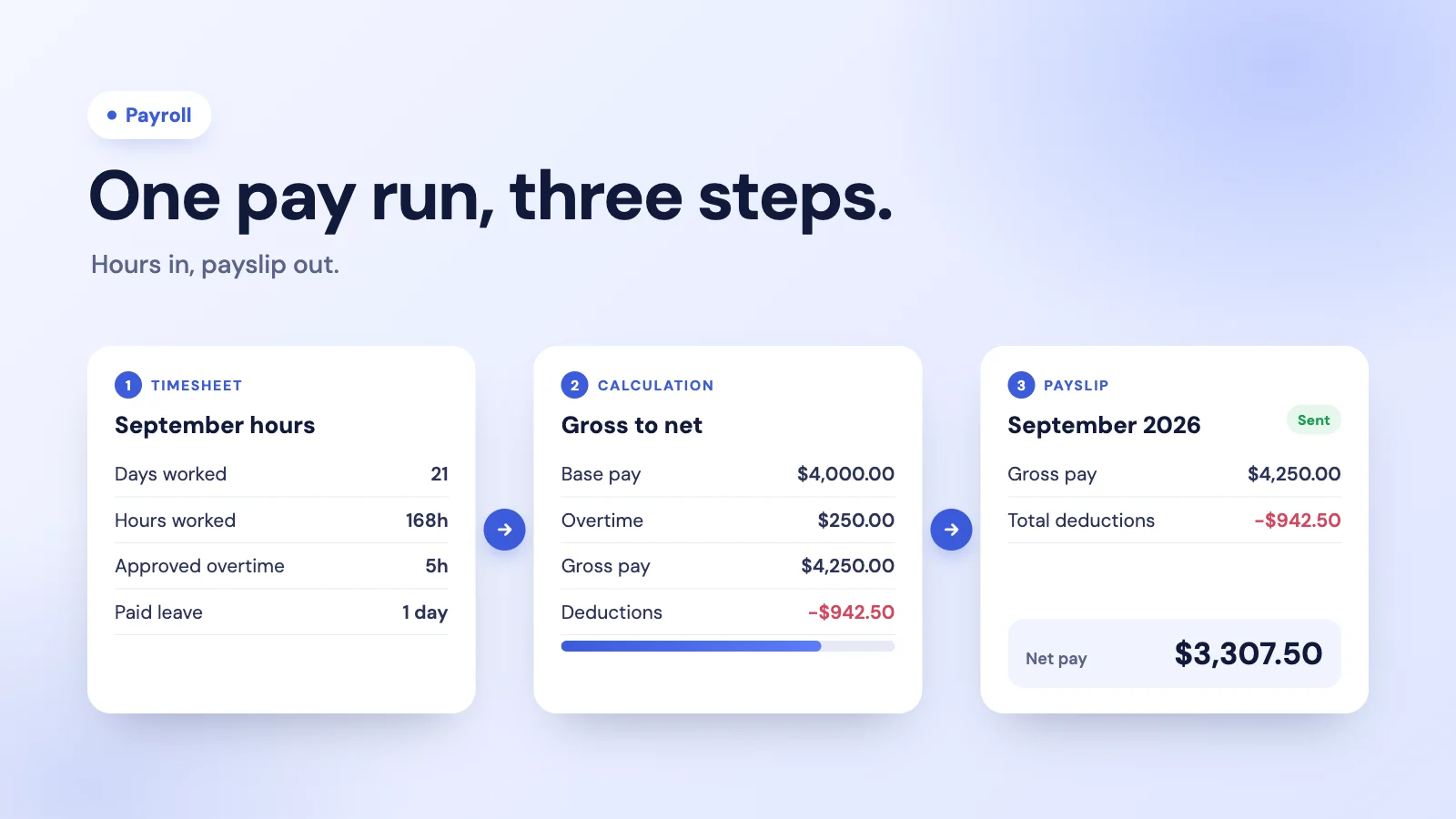
- Calculate pay: gross pay, then deductions, then net pay.
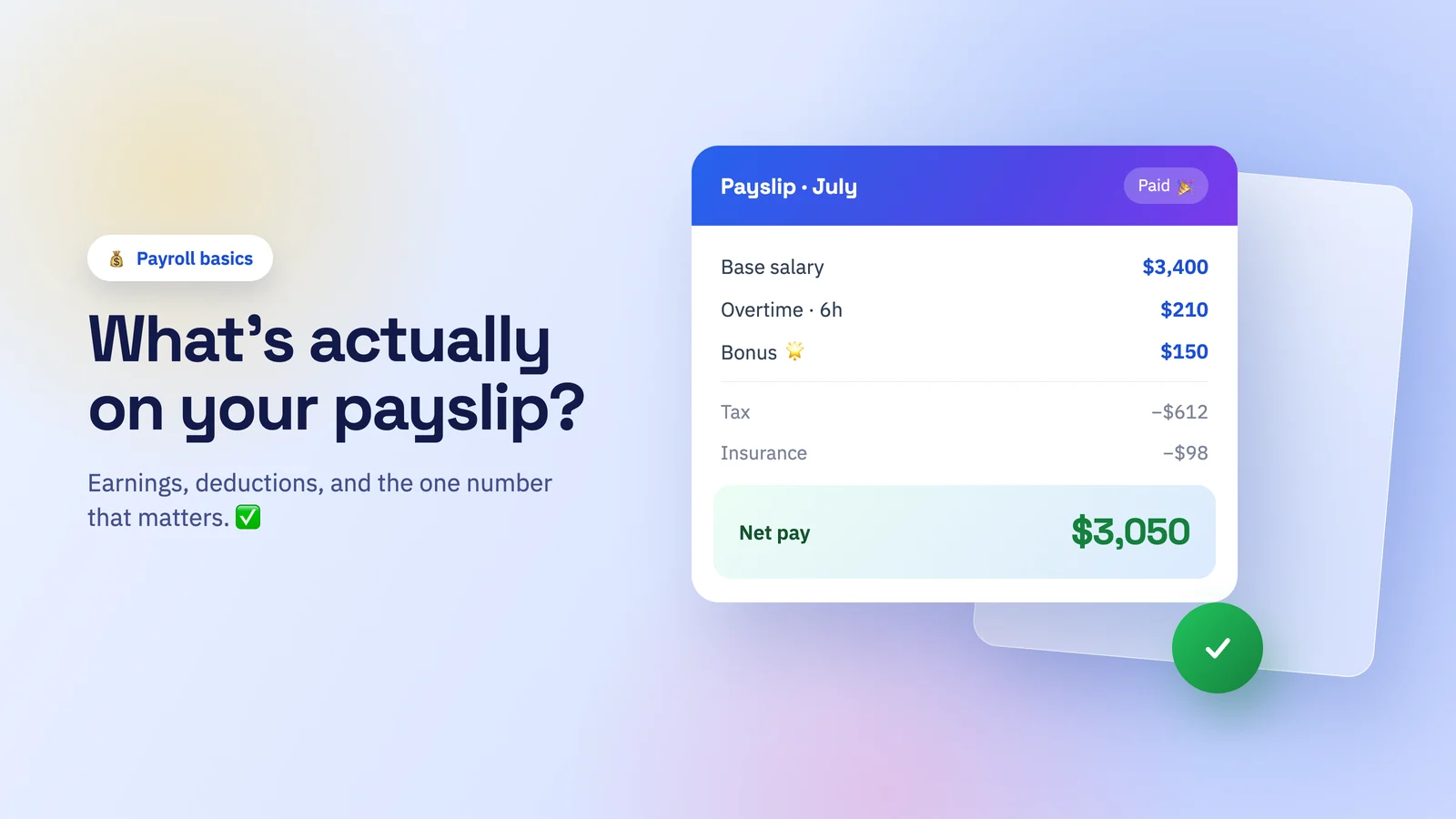
- Produce payslips so each person can see how their pay was reached.
- Pay people: move the money from your bank to theirs.
- Pay and file payroll taxes with the tax authorities, on their deadlines.
- Keep records for audits and year-end.
The difference between software and a service is which of these steps someone else does for you.
What payroll software does
Payroll software handles the calculation: steps 1 to 3, and the records in step 6. You put in, or connect, the hours, leave and pay rules, and it produces gross pay, deductions, net pay and a payslip for each person.
What it usually does not do is move money or deal with the tax authorities. You pay people from your bank, and you or your accountant file the returns.
It suits you if:
- you have an accountant who already handles filings, or a simple tax position;
- you want control over the figures and the timing of payments;
- you want lower running costs, typically a per-employee subscription.
What a payroll service does
A payroll service, often sold as full-service payroll, does the calculation and also steps 4 and 5: it pays your employees, usually by direct deposit, withholds and pays payroll taxes, and files the returns on time. Many also issue year-end forms and handle registrations when you hire in a new state or country.
Some go further. A professional employer organization (PEO) becomes a co-employer for HR and benefits purposes, and an employer of record (EOR) legally employs people on your behalf, often in other countries.
It suits you if:
- nobody in the business wants to own tax filings and deadlines;
- you employ people in several states or countries;
- the cost of a late or wrong filing would hurt more than the service fee.
Side by side
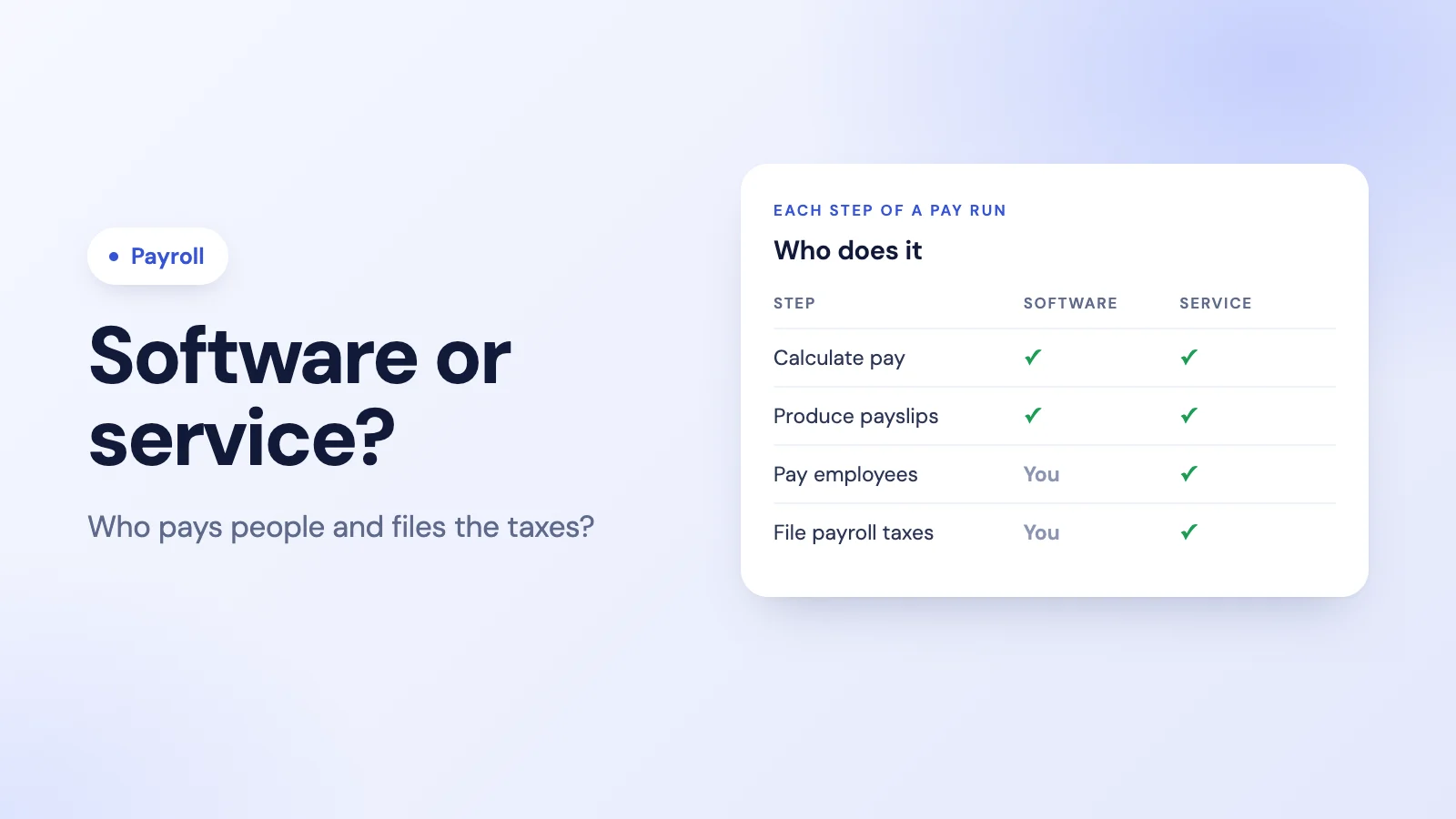
| Step | Payroll software | Payroll service |
|---|---|---|
| Calculate pay and deductions | Yes | Yes |
| Produce payslips | Yes | Yes |
| Pay employees | You, through your bank | The service |
| Pay and file payroll taxes | You or your accountant | The service |
| Year-end forms | Usually you or your accountant | Usually the service |
| Who owns filing mistakes | You | Shared, depending on the contract |
| Typical cost | Lower, per employee | Higher, per employee plus a base fee |
The questions that decide it
- Who will file payroll taxes? If the honest answer is "nobody, reliably", choose a service or keep an accountant who does it.
- How many places do you employ people? Each state or country adds registrations and rules. A service earns its fee faster with every new location.
- How much control do you want? Software lets you check every figure and choose when money moves. A service runs on its schedule.
- What do you already pay for? If an accountant already files for you, software plus that accountant may cost less than a full service.
- Where do your inputs live? Pay is only as accurate as the hours, leave and overtime behind it. Wherever it runs, payroll should read them from the system that records them, not from a re-typed spreadsheet.
A common middle path
Many small businesses combine the two: payroll software produces the figures and payslips from the hours and leave the team already records, an accountant files the taxes from those figures, and the business pays people from its bank. It keeps costs down without leaving filings to chance.
Where Tickin fits
Tickin is payroll software, not a payroll service. On the Growth plan and above it calculates each person's pay from the attendance, leave and approved overtime already in your workspace, lets an admin preview the run before confirming it, and sends each employee an itemized PDF payslip. The Scale plan adds weekly pay and hourly rates.
It includes income-tax presets for 17 markets as a starting point that an admin reviews and confirms. They cover the most common salaried case rather than every rule: the US preset, for example, is federal income tax only. Tickin does not pay employees or file taxes; paying salaries and filing returns stay with you, your bank or your accountant.
See payroll in Tickin, the payroll processing checklist, and how payroll deductions and payslips work.
Frequently asked questions
What is the difference between payroll software and a payroll service?
Payroll software calculates pay and produces payslips, and you pay people and file taxes yourself or through your accountant. A payroll service, often called full-service payroll, does those last steps for you: it moves the money and files the payroll taxes and returns.
Do I need a payroll service for a small business?
Not always. If you have a few employees, an accountant who already handles filings and a bank that makes payments, payroll software can be enough. If you employ people in a country with complex payroll tax filings and nobody to file them, a payroll service or accountant is usually worth it.
What does a full-service payroll provider do?
It calculates pay, withholds and pays payroll taxes, files the required returns, pays employees by direct deposit and issues year-end forms. Some also handle benefits or registrations in new states or countries.
Is Tickin a payroll service?
No. Tickin is payroll software: on the Growth plan and above it calculates pay from attendance, leave and overtime and produces itemized payslips. It does not pay employees or file taxes; those stay with you, your bank or your accountant.
Can I use payroll software and an accountant together?
Yes, and many small businesses do. The software produces accurate pay figures and payslips from your records; the accountant uses them to file, and your bank makes the payments.
The takeaway
Payroll software works out the pay; a payroll service also pays people and files the taxes. Decide who will own those last two steps. If someone reliable already does, software is usually enough. If nobody does, pay for a service or an accountant, because a missed filing costs more than either.