Pay Frequency: Weekly vs Biweekly vs Semi-Monthly vs Monthly
Weekly, biweekly, semi-monthly or monthly pay: how many paydays each gives, how per-period pay is worked out, and how to choose a pay frequency for your team.
How often you pay people shapes more than the payroll calendar. It decides how big each paycheck is, how often someone has to check hours and overtime, how much admin you take on, and, in some places, whether you are following the law.
This guide compares the four common pay frequencies, shows how per-period pay is calculated for each, and gives a short checklist for choosing one.
The four pay frequencies at a glance
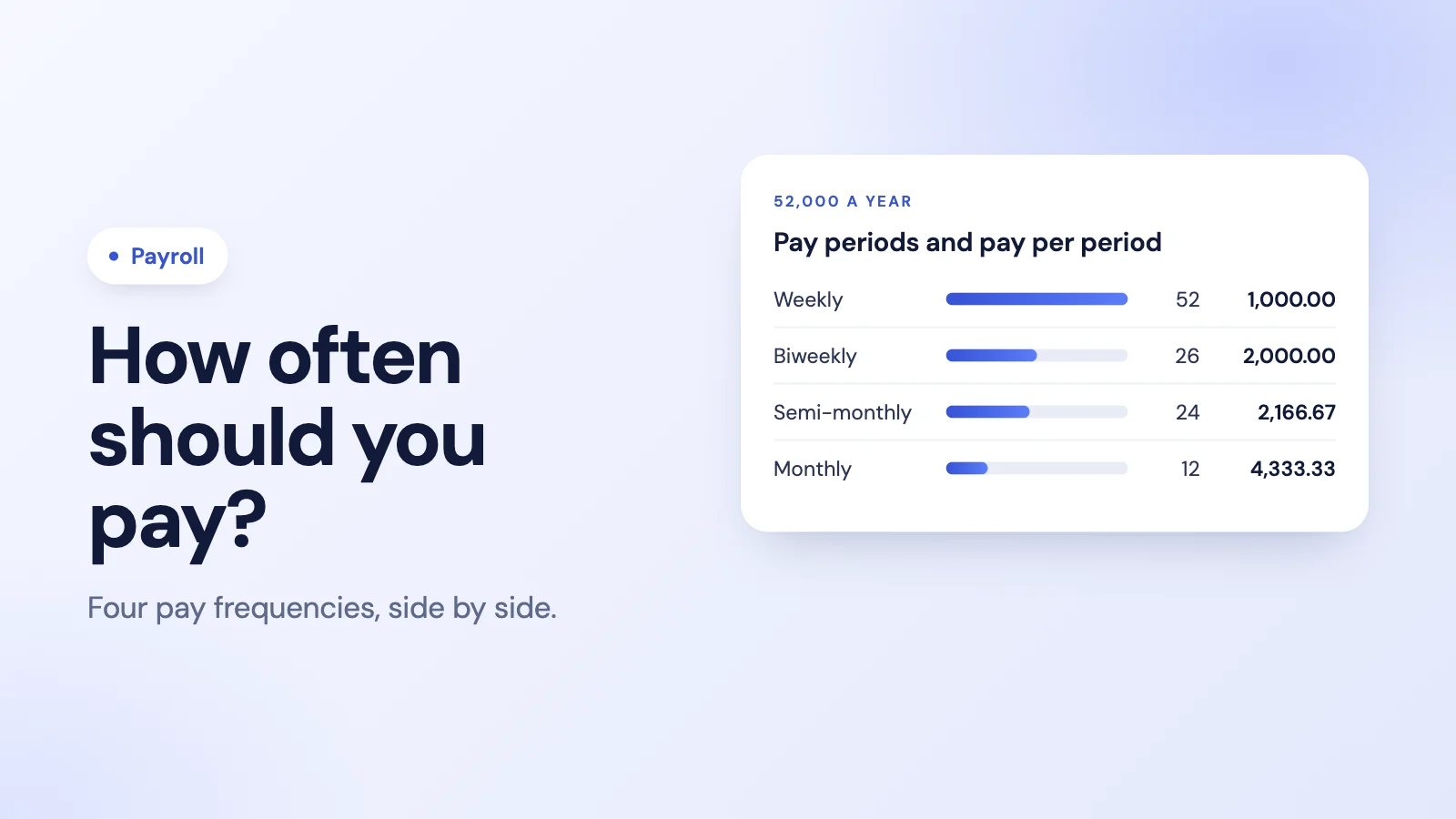
| Frequency | Paid | Pay periods a year | Pay per period on a 52,000 salary |
|---|---|---|---|
| Weekly | Every week, same weekday | 52 | 1,000.00 |
| Biweekly | Every two weeks, same weekday | 26 | 2,000.00 |
| Semi-monthly | Twice a month, fixed dates | 24 | 2,166.67 |
| Monthly | Once a month | 12 | 4,333.33 |
For salaried staff, pay per period is the annual salary divided by the number of periods. For hourly staff, it is the hours worked in the period times the rate, plus any overtime.
Weekly pay
Weekly pay suits hourly and shift teams, where pay follows hours and people value getting paid quickly. Overtime is usually easiest to calculate weekly, because many overtime rules are based on hours in a week. For the weekly routine itself, see how to run weekly payroll.
The cost is admin: 52 pay runs a year means 52 rounds of checking hours, approving overtime and producing payslips. Some years contain 53 paydays of a given weekday, which matters for salaried pay and budgets.
Biweekly pay
Biweekly pay, every other week on the same weekday, is common in the United States. It halves the number of runs compared with weekly and still keeps pay periods aligned to whole weeks, which keeps weekly overtime simple.
Because 52 weeks give 26 paydays, two months a year contain three paydays. Employees often like those months; budgets need to plan for them. Some years have 27 biweekly paydays.
Semi-monthly pay
Semi-monthly pay comes twice a month on fixed dates, such as the 15th and the last day of the month. That gives exactly 24 paydays and equal salary amounts each time, which lines up neatly with monthly bills and benefit deductions.
The catch is that pay periods do not match whole weeks. A period might run from a Wednesday to a Thursday, which makes weekly overtime harder to calculate, and paydays move to the nearest working day when a date falls on a weekend or holiday.
Monthly pay
Monthly pay is the norm in many countries and the simplest to run: twelve pay runs a year, one set of approvals each month, and pay periods that match the calendar. It works well for salaried teams.
For hourly staff, a month is a long wait between paydays, and overtime from early in the month is paid weeks later. Some employers offer advances for that reason.
How to choose a pay frequency
- Check the law first. Many jurisdictions set a minimum pay frequency, sometimes different for hourly and salaried staff. That may decide the question for you.
- Look at how your people are paid. Hourly and shift workers usually prefer weekly or biweekly; salaried teams are often fine with monthly.
- Look at how overtime is calculated. If your overtime rules are weekly, pay periods built from whole weeks are easier.
- Be honest about admin capacity. Every pay run means checking hours, approving overtime and producing payslips. More frequent pay means more of that work.
- Consider cash flow. More frequent pay means smaller, more frequent outflows; less frequent pay means larger ones.
- Pick one and keep it stable. Changing frequency is possible but needs notice and a careful transition period.
Whatever you choose, the steps of each run stay the same. Our guide to what payroll involves walks through them, and the payroll processing checklist keeps them in order.
How frequency affects deductions and overtime
- Deductions are usually calculated per period, so a monthly deduction has to be split across the periods in a month for weekly or biweekly pay. Our guide to payroll deductions explains how they work.
- Overtime under a weekly rule is calculated week by week, even when you pay monthly. See how to calculate overtime pay.
- Payslips should show the pay period clearly, so people can match hours to pay.
Pay frequency in Tickin
Tickin's payroll, on the Growth plan and above, calculates pay and produces payslips from the hours, leave and overtime your team already records. Here is what it supports today:
- Monthly pay on the Growth plan and above.
- Weekly pay on the Scale plan, along with hourly and weekly rates and weekly overtime.
- A mix of both. On Scale, some employees can be paid weekly and others monthly in the same workspace.
- Not supported: biweekly and semi-monthly cycles. If you need those, Tickin's payroll is not the right fit for that part of your process today.
Tickin calculates pay and produces payslips; it does not pay employees or file taxes. Payments and filings stay with you, your bank or your accountant. See payroll in Tickin, or how teams automate salary slips.
Frequently asked questions
What is the difference between biweekly and semi-monthly pay?
Biweekly pay comes every two weeks on the same weekday, which gives 26 paydays a year and, twice a year, a month with three paydays. Semi-monthly pay comes twice a month on fixed dates, such as the 15th and the last day, which gives exactly 24 paydays a year.
How many pay periods are there in a year?
Weekly pay has 52 pay periods a year (occasionally 53), biweekly 26 (occasionally 27), semi-monthly 24 and monthly 12.
Which pay frequency is best for a small business?
There is no single best choice. Monthly is simplest to run and common in many countries; weekly or biweekly suits hourly teams who prefer frequent pay. Check what the law requires where you employ people, then choose the frequency your team and your payroll process can sustain.
Can I change my pay frequency?
Usually yes, with notice to employees and care over the transition period so nobody is paid twice or skipped. Some places restrict how and when the frequency can change, so check the local rules and plan the first changed period carefully.
Which pay cycles does Tickin support?
Tickin's payroll, on the Growth plan and above, runs monthly. The Scale plan adds weekly pay, and a workspace can mix weekly and monthly employees. Tickin does not run biweekly or semi-monthly cycles, and it calculates pay and payslips rather than paying employees or filing taxes.
The takeaway
Weekly gives 52 paydays, biweekly 26, semi-monthly 24 and monthly 12. Start with what the law requires, then match the frequency to how your people are paid, how your overtime rules work and how much payroll admin you can sustain, and keep it stable once you have chosen.