Bradford Factor: How to Calculate It, and When to Use It
The Bradford factor explained: the formula, worked examples, typical trigger points, and the fairness and legal cautions to weigh before using it for absence.
The Bradford factor is a single number that tries to capture how disruptive someone's absences have been. It became popular because it is easy to calculate and draws attention to a pattern that simple day-counts miss: frequent, short, unplanned absences.
It is also easy to misuse. This guide explains the formula, works through examples, and covers how to use it fairly, or whether to use it at all.
The Bradford factor formula
B = S × S × D
- S is the number of separate spells of absence in the period.
- D is the total number of days absent in the period.
- The period is usually a rolling 52 weeks.
A spell is one continuous absence, however long. Off Monday and Tuesday is one spell of two days. Off Monday, back Tuesday, off Wednesday is two spells of one day each.
Worked examples
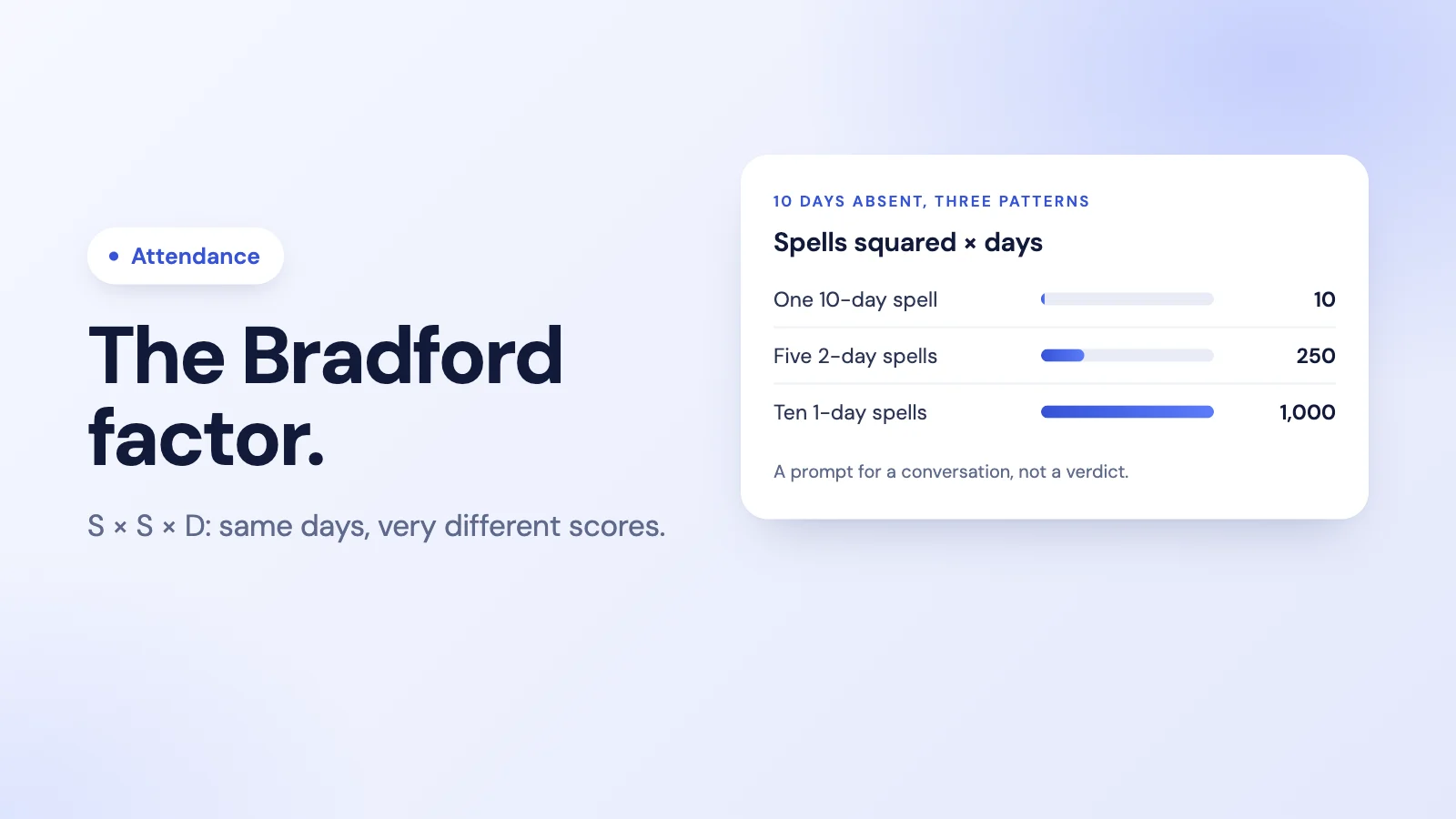
All three people below were absent for 10 days in a year. Their scores could hardly be more different.
| Person | Pattern | S | D | Bradford factor |
|---|---|---|---|---|
| Ana | One 10-day absence | 1 | 10 | 1 × 1 × 10 = 10 |
| Sam | Five 2-day absences | 5 | 10 | 5 × 5 × 10 = 250 |
| Lee | Ten 1-day absences | 10 | 10 | 10 × 10 × 10 = 1,000 |
Squaring the number of spells is the whole point. It reflects the idea that ten unplanned single days, each needing last-minute cover, disrupt a team more than one planned or predictable absence of the same total length.
Trigger points
There is no official scale. Employers that use the Bradford factor choose their own trigger points, usually as stages in an absence policy. Examples often quoted are:
- around 50: an informal conversation
- around 125: a more formal review
- around 400 and above: further formal stages
Treat any numbers like these as a starting point to adapt, not a standard. And make the trigger a prompt for a conversation, never an automatic warning.
The cautions
The same squaring that makes the Bradford factor sensitive to patterns also makes it blunt.
- It ignores the reason. A person managing a long-term condition, or caring for someone, may have frequent short absences for entirely legitimate reasons.
- It can conflict with the law. In some countries, including the UK, employers must make reasonable adjustments for disabled employees and must not count pregnancy-related absence against someone. A score that includes those absences can lead to unfair, and unlawful, decisions. Take advice on the rules where you operate.
- It can encourage presenteeism. People who know their score is watched may come in sick to avoid starting a new spell, which spreads illness and lowers productivity.
- It says nothing about the cause. A high score is a reason to talk, not a diagnosis.
How to use it fairly
If you decide to use the Bradford factor:
- Put it in your policy. Explain the formula, the period and the trigger points in your attendance policy, so nobody is surprised.
- Decide what does not count. Exclude absences related to disability or pregnancy, and consider excluding other protected or pre-approved absences. Apply the exclusions consistently.
- Use it to start a conversation. Ask what is going on and what would help. Often the answer is workload, health or caring responsibilities, not commitment.
- Look at it alongside other measures. An attendance rate shows how much time was lost; the Bradford factor shows how it was spread.
- Review the policy itself. If many people hit trigger points, the problem may be the workplace, not the people. Our guide on how to reduce absenteeism covers the usual causes.
Short-term sickness is where the Bradford factor bites hardest, so make sure your sick leave policy and your absence policy say the same thing.
Where Tickin fits
Tickin does not calculate the Bradford factor. What it does is keep the records you would need to calculate it, in one place:
- Leave requests and approvals, including sick leave and any leave types you set up, on every plan.
- Daily attendance from clock-ins in Slack, on the web or in the optional Desktop App (and Microsoft Teams on the Scale plan).
- CSV exports of leave and attendance records on the Growth plan and above, so you can count spells and days in a spreadsheet if you choose to use the score.
See leave management in Tickin, or our attendance policy template for a starting point on the policy itself.
Frequently asked questions
What is the Bradford factor formula?
B = S × S × D, where S is the number of separate spells of absence in the period (usually the last 52 weeks) and D is the total number of days absent. Two spells totalling 4 days gives 2 × 2 × 4 = 16.
What is a high Bradford factor score?
There is no official scale. Employers set their own trigger points; examples often quoted are around 50 for an informal conversation and several hundred for formal stages. Whatever you use, the score should prompt a conversation, not an automatic sanction.
Why does the Bradford factor punish frequent short absences?
Because the number of spells is squared. That is deliberate: it reflects the view that frequent, unplanned short absences disrupt a team more than one long, planned absence. It is also its main weakness, because some people have good reasons for frequent short absences.
Is the Bradford factor fair?
It can be, if it is used as a prompt for a conversation, applied consistently, and adjusted for absences that should not count, such as those related to a disability or pregnancy. Used mechanically, it can treat people with long-term health conditions unfairly and, in some countries, unlawfully.
Does Tickin calculate the Bradford factor?
No. Tickin records leave, including sick leave, and attendance, and on the Growth plan and above you can export leave records as CSV to calculate the Bradford factor in a spreadsheet. It does not compute the score itself.
The takeaway
The Bradford factor squares the number of absence spells and multiplies by the days absent, so frequent short absences score far higher than one long one. It is quick to calculate and good at surfacing patterns, but blind to reasons. If you use it, write it into your policy, exclude absences that should not count, and treat every trigger point as the start of a conversation.