How to Calculate Attendance Rate (Formula and Examples)
How to calculate an employee attendance rate and absenteeism rate, with worked examples, what to count as scheduled days, and how to read the number fairly.
An attendance rate is one of the few HR numbers almost every team can calculate from data it already has. It is also one of the easiest to get subtly wrong, because the answer depends entirely on what you count as a scheduled day and what you count as an absence.
This guide gives the formula, works through examples for one person and a whole team, and covers the definitions that make the number fair.
The attendance rate formula
Attendance rate = days attended ÷ days scheduled × 100
And its mirror image:
Absenteeism rate = days absent ÷ days scheduled × 100
The two always add up to 100%, so pick whichever reads better for your purpose. Attendance rate sounds positive; absenteeism rate draws attention to the problem.
Example: one employee, one month
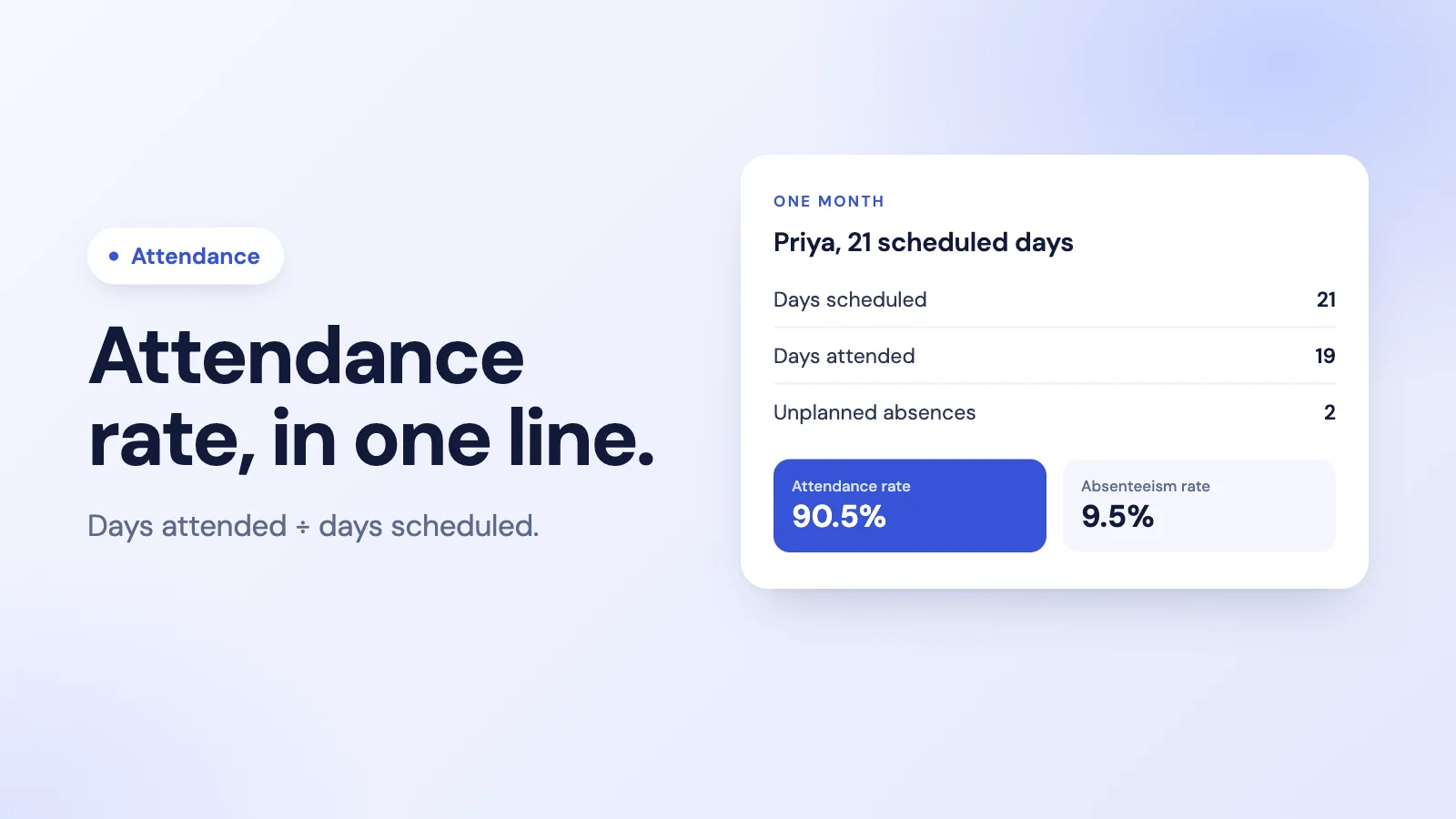
Priya's month looks like this:
- Working days in the month: 22
- Public holiday: 1
- Approved annual leave: 0
- Days she was scheduled to work: 21
- Days she did not come in and had no approved leave: 2
- Days attended: 19
Attendance rate = 19 ÷ 21 × 100 = 90.5% Absenteeism rate = 2 ÷ 21 × 100 = 9.5%
Example: a whole team
For a team, add everything up before you divide. Do not average the individual percentages, because people with fewer scheduled days would count as much as people with more.
| Person | Scheduled days | Days attended |
|---|---|---|
| Priya | 21 | 19 |
| Sam | 21 | 21 |
| Lena | 16 | 16 |
| Omar | 21 | 20 |
| Ana | 21 | 21 |
| Team | 100 | 97 |
Team attendance rate = 97 ÷ 100 × 100 = 97.0%
Lena was on approved leave for five days, so she was scheduled for 16, not 21.
What counts as a scheduled day
This is where most attendance rates go wrong. A scheduled day is a day the person was expected to work. So, before you calculate:
- Take out weekends and other non-working days in their schedule.
- Take out public holidays.
- Take out approved leave, such as annual leave or parental leave.
- Decide how you treat part-days, such as half-day leave. Counting them as 0.5 is the usual approach.
If you leave approved leave in, someone who took a planned two-week holiday looks like they have an attendance problem. That is not what you want the number to say.
What counts as an absence
Most teams count unplanned absences: days someone was expected and did not work without approved leave. Some also count unplanned sick days separately. A few track late arrivals too, but lateness is better reported on its own, because mixing it into attendance hides both signals.
Write your definitions down, apply them to everyone in the same way, and keep them stable over time so this month can be compared with last month.
Reading the number fairly
An attendance rate tells you that something changed, not why. A few habits keep it useful:
- Look at trends, not single months. One bad month is often one bad week of flu.
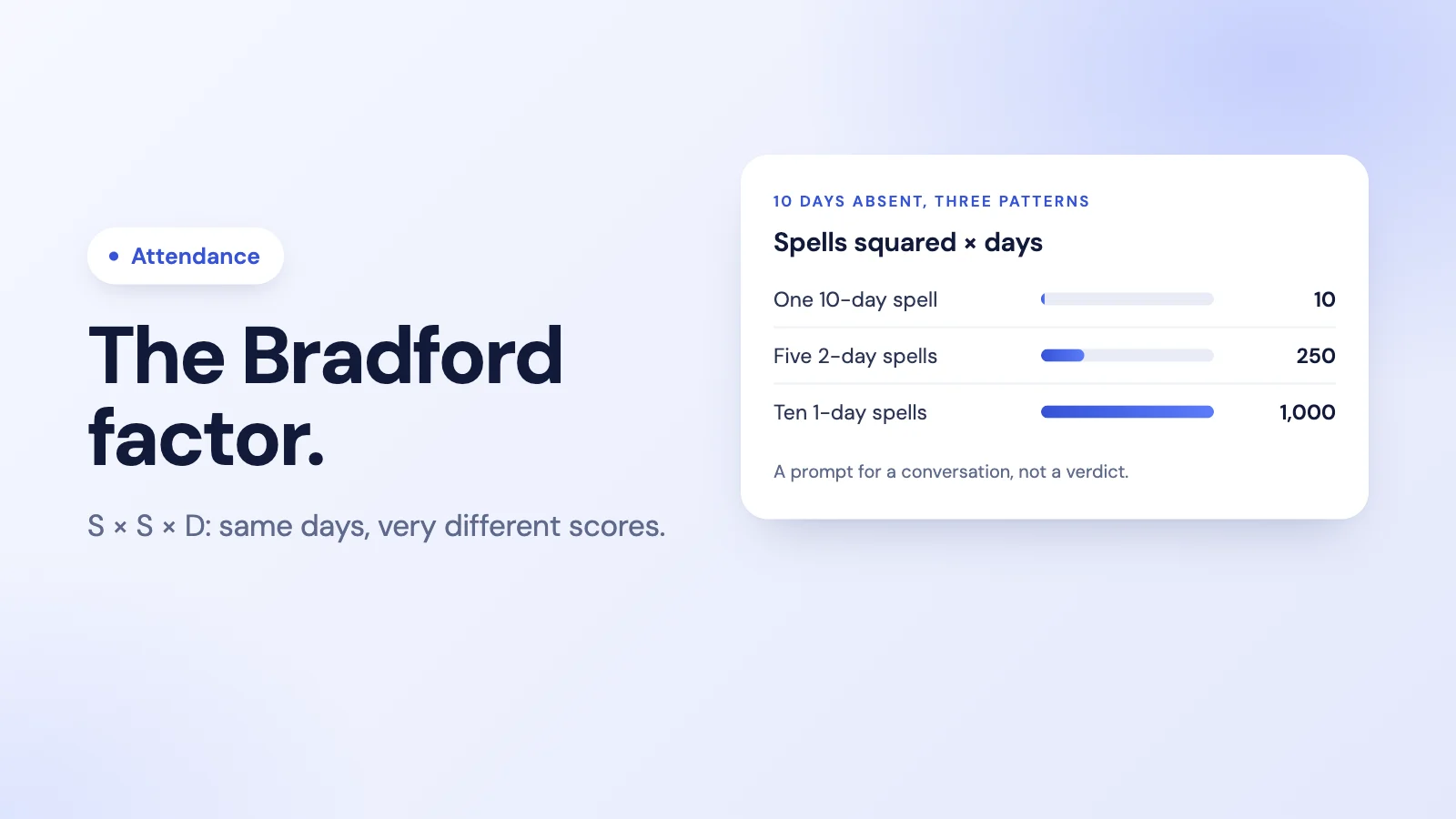
- Look for patterns. Repeated Monday absences say something different from one long illness. Short, frequent absences are what the Bradford factor was designed to highlight.
- Talk before you act. Low attendance is often a symptom of workload, caring responsibilities or health. Our guide on how to reduce absenteeism covers the causes and the fixes.
- Make the rules clear in advance. An attendance policy that explains what is expected, and what counts as an absence, prevents most arguments later.
Remote teams can use the same formula, as long as "attended" means clocked in for the day rather than present in an office. Our guide to tracking attendance for a remote team covers how.
Where Tickin fits
Tickin records the raw material: who clocked in each day from Slack, the web or the optional Desktop App, who was on approved leave or working from home, and who arrived late or left early if you switch on grace-period tracking. The web dashboard shows who has not clocked in today, and on the Growth plan and above you can export the detailed records as CSV to calculate rates for any period.
Tickin's chat reports also show an Attendance %. Be aware of what it measures: days present out of days present plus approved leave days, for the report's period. It does not compare attendance with scheduled days or count unplanned absences, so it is a present-versus-on-leave figure, not the attendance rate described above. For the full formula, use the CSV export with your own scheduled days.
See attendance tracking in Tickin, or how teams use it in HR software for small businesses.
Frequently asked questions
What is the formula for attendance rate?
Attendance rate = days attended ÷ days scheduled × 100. If someone was scheduled for 21 days and attended 19, their attendance rate is 19 ÷ 21 × 100 = 90.5%.
What is the difference between attendance rate and absenteeism rate?
They are two sides of the same number. Absenteeism rate = days absent ÷ days scheduled × 100, so with 2 absences out of 21 scheduled days the absenteeism rate is 9.5% and the attendance rate is 90.5%.
Should approved leave count as an absence?
Usually not. Approved holidays and planned leave are normally taken out of scheduled days before you calculate, because the person was not expected to work. Most teams count only unplanned absences, such as unreported days off, against the attendance rate. Whatever you choose, apply it the same way to everyone.
What is a good attendance rate?
There is no universal benchmark, because it depends on how you define scheduled days and absences. Compare a team with its own history and look for changes and patterns, rather than chasing a single target number.
How do you calculate attendance rate for a whole team?
Add up the days attended by everyone and divide by the total days everyone was scheduled. Five people scheduled for 21 days each gives 105 scheduled days; if they attended 99 between them, the team attendance rate is 99 ÷ 105 × 100 = 94.3%.
The takeaway
Attendance rate is days attended divided by days scheduled, times 100. The arithmetic is trivial; the definitions are not. Take approved leave and holidays out of scheduled days, count unplanned absences the same way for everyone, and read the result as a trend to talk about, not a score to punish.